Showing posts with label screen legends. Show all posts
Labels: , , , , , , ,

When Icons Bid Adieu: Screen Legends Who Died in 2013


The passing of 2013 also meant good-byes to a number of the already-handful screen legends we have today. 

Deanna Durbin (December 4, 1921 – c. April 20, 2013) 

Deanna Durbin
Deanna Durbin wowed Depression- and World War II-era moviegoers with her “sweet, soprano voice” and for her depiction of the ideal teenage daughter in films such as Three Smart Girls (1936). In 1938, together with Mickey Rooney, she was honored with a Juvenile performer Academy Award for her “significant contribution in bringing to the screen the spirit and personification of youth …” Deanna walked out from Hollywood by 1950, still at the height of her career. She remained a recluse until her death. 

Esther Williams (August 8, 1921 – June 6, 2013) 

Esther Williams
Dubbed as the “Million-Dollar Mermaid,” Esther Williams wasn’t just a popular star of the 1940s, she was also an accomplished swimmer. She was one of the biggest box-office stars of the 1940s, appearing watery MGM extravaganzas, such as Bathing Beauty (1944), Neptune’s Daughter (1949), Million Dollar Mermaid (1952) and Jupiter’s Darling (1955). 

Elliott Reid (January 16, 1920 – June 21, 2013) 

Elliott Reid (with Pat Conway)
Character actor Elliott Reid had his share of fame after playing the role of Ernie Malone, private detective who spied on Marilyn Monroe's character only to fall in love with Jane Russell’s role in Gentlemen Prefer Blondes (1953). 

Barbara Lawrence (February 24, 1930 – November 13, 2013) 

Barbara Lawrence
Barbara Lawrence is perhaps best-remembered for portraying the role of Gertie Cummins in Oklahoma! (1953) in which she got into a catfight with Gloria Grahame’s role. 

Eleanor Parker (June 26, 1922 – December 9, 2013) 

Eleanor Parker
Dubbed as the “Woman with the Thousand Faces” for her versatility, Eleanor Parker was hugely praised for her ease in portraying various characters in drama, comedy, or horror. She earned the raves of critics for her Oscar-nominated performances as a prison inmate in Caged (1950), a detective’s wife in Detective Story (1951), and Marjorie Lawrence in the biopic Interrupted Melody (1955). However, her most unforgettable role was a supporting one, as the marriage-minded baroness in The Sound of Music (1965). 

Peter O'Toole (August 2, 1932 –December 14, 2013) 

Peter O'Toole
Considered one of the best English actors of his generation, Peter O’Toole earned overnight fame with, in the words of New York Times, “a hell-raising streak” of a performance in Lawrence of Arabia. The performance earned him his first Oscar nomination and he continued his career with seven more nominations for the following films: Becket (1964), The Lion in Winter (1968), Goodbye, Mr. Chips (1969), The Ruling Class (1972), The Stunt Man (1980), My Favorite Year (1982) and Venus (2006). Together with Richard Burton, he held the record of having the most Oscar nomination for best actor without a single win, although he was honored with an Honorary Oscar in 2003. 

Joan Fontaine (October 22, 1917 – December 15, 2013) 

Joane Fontaine
Throughout the 30s, Joan Fontaine managed to play lackluster parts until her performance in The Women and Gunga Din (both 1939) gave her to opportunity to somewhat showcase her acting prowess. However, her most stellar—and near Oscar-winning moment—came when she played as the haunted second wife in Alfred Hitchcock’s Rebecca (1940). She won the Oscar for another Hitchcock vehicle, Suspicion (1941), and saw her career thrive in Jane Eyre (1944), The Constant Nymph (1943), for which she earned her third Oscar nomination, A Letter From an Unknown Woman (1948), Ivanhoe (1952); and Island in the Sun (1957). Fontaine’s personal spat with her sister, Olivia de Havilland was also the talk of Hollywood to this day.  The two never fully reconciled.

0 comments
Labels: , , ,

Alicia Rhett, Oldest Surviving Gone with the Wind Actress, Diest at 98

Alicia Rhett. Image: Wikimedia
While a lot of damsels-in-distress would go heed to the call of stardom, Alicia Rhett was an exception. Instead, she chose to follow what she wanted most in life: pursue a life in arts and become Charleston's most avid lover. She did not lack the beauty, said Bill Trawick, CEO of the Bishop Gadsden Episcopal Retirement Community in Charleston, where she has lived since 2002, until she died January 3, 2014. But she had innate passion for privacy, one thing that she could not have had had she become a Hollywood celebrity.

Rhett was born in Savannah, Georgia, on February 1, 1915. Her mother was Isabelle Murdoch, who moved South from Liverpool, England. Her father was Edmund M. Rhett, an American army officer and engineer based in Savannah. Her father died during World War I, prompting Alicia and her mother to move to Charleston, South Carolina, where she worked as a theater actress.

While performing in The Recruiting Officer in 1936, Hollywood director, George Cukor spotted her while scouting for actresses to portray Scarlett O'Hara for the film Gone Wind the Wind. Margaret Mitchell wrote the best-selling novel, but David Selznick bough the film rights. Rhett's beauty and charm was noticed by Cukor. While she failed to grab the role of Melanie, which she auditioned for, she was eventually offered to play the role of India, sister of Ashley Wilkes. This was the first and only motion picture role that Rhett ever played. After Gone with the Wind, she left Hollywood and forevermore turned her back from the movie world.

0 comments
Labels: , , , , ,

Pinoy Screen Legend: Alice Vergel—The Action Queen of Philippine Cinema

Alicia Vergel. Image: Beverly Vergel
It is a rarity among actors and actresses today to possess certain versatility in the way they project themselves in the camera. Some are good in drama, others excel in comedy, many though are simply too good-looking to give a rousing performance. But the same could never be said of Alicia Vergel, the screen thespian who reigned in the 50s and 60s. She was pretty as much as she was talented and versatile as a performer. She proved her mettle in action flicks many times over but more than held her own in a slew of drama and comedy features, too. But among her many performances, it was her stint in the action genre that made her the indelible and unforgettable queen of action movies. She had such an agile physique that she didn’t need to have a double to perform even the riskiest scenes actresses of her days dared not do. Years later, she entered public service and kept her life literally in “action” despite the lack of klieg and glitter that filmdom had to offer. Nevertheless, she sporadically lent her acting prowess to a few but worthwhile pictures in the 70s and 80s. These, she did while staying true to the vow of motherhood, rearing her children, who themselves carved their niches in show business. Indeed, Alicia Vergel is one, true lady for all seasons.

Early Years in Acting

Alicia Vergel started her acting career in Sampaguita Pictures, where she had a cameo role in the Tita Duran-Pancho Magalona starrer Milagro ng Birhen ng mga Rosas, a 1949 film that depicted a real-life miraculous event in Lipa, Batangas. In 1950, she landed a role in a “dream sequence” production number in the musical Huwag Ka Nang Magtampo. The film also saw Paraluman, Linda Estrella, Lillian Leonardo, Maria Corazon, Lita Rio, Norma Vales and Tessie Quintana do the routine performances.

Career Heights

Huling Patak ng Dugo (1950)

Bernardo Carpio (1951)

Berdugo ng mga Anghel (1951)

Basahang Ginto (1952)
Madam X (1952)
Alicia Vergel’s star began to shine after being cast opposite Pancho Magalona in the action flick Huling Patak ng Dugo in 1950. This was when she saw promise as a leading-lady doubled as an action star. She eventually reigned supreme as the country’s Queen of Action Movies, appearing opposite reel and real life romantic partner Cesar Ramirez in such films as Bernardo Carpio (1951), Espada (1952), Diwani (1953), Ukala (1954), and Lupang Hinirang (1955), perhaps their most unforgettable film together.

MN (1954)

Ukala: Ang Walang Suko (1954)

Balisong (1955)

Lupang Kayumanggi (1955)

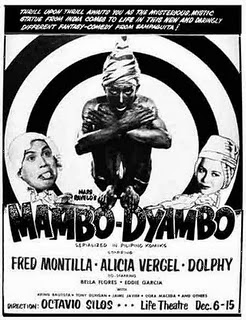
Mambo-Dyambo (1955)
Vergel was also comfortable in starring with other leading mans, including Fred Montilla in Tenyente Ramirez (1951), Oscar Moreno in Dugong Bughaw (1951) and Ramon Revilla in Balisong (1955). Vergel was equally adept in drama and in comedy, as she was at home in performing feisty and tough characters. For her dramatic outings, she was well-received in Madam x (1952), where her character was based on the life of a millionairess and in MN (1954), where her durability as an actress came face to face with drama queen Carmen Rosales’ own. Her stint in comedy, especially in the film Mambo-Jumbo (1955) opposite Dolphy was also well-received by audience and critics alike.

Taong Putik (1956)

Kahariang Bato (1957)

Maskara (1957)
 With the end of her contract in Sampaguita, Vergel decided to freelance. While her status as a top leading lady considerably diminished during this time, Vergel’s acting skills remained evident though in such films as Bicol Express (1957), Day of the Trumpet (1958), Kadenang Putik (1960), NBI (1961) and Viva Caballeras (1961).
The Day of the Trumpet (1957)

Anak ng Lasengga (1958)

Cavalry Command (1958) 

Obra Maestra (1958)
Thereafter, Vergel kept herself busy as a public servant after getting elected as barangay captain of Brgy. Santo Domingo in Quezon City, a position she held for 22 years. She occasionally got lured from semiretirement whenever meaty roles came her way, such as starring with her own son Ace Vergel in the film Inay (1977). She also lent her dramatic appeal in such tearjerkers as Saan Nagtatago ang Pag-ibig? (1987), Isusumbong Kita sa Diyos (1998) and Mundo Man Ay Magunaw (1990).

Kadenang Putik (1960)

Inay (1977)

Saan Nagtatago ang Pag-ibig? (1987)
Career Achievements

Vergel’s career has been highlighted by many spotlights. In a time when actresses used doubles when doing difficult stunts, Vergel insisted on doing them on her own. She was also the only actress during her generation to enjoy enormous popularity as an action film regular. In the awards department, Vergel was the first actress to grab the Maria Clara Award for Best Supporting Actress for her role in Mapuputing Kamay (1950). She was also the first actress to win the Filipino Academy of Movie Arts and Sciences (FAMAS) award for Best Actress for her role in Basahang Ginto (1952).

Personal life


Alicia Vergel was born on June 7, 1927. Her real name was Erlinda Gaerlan Asturias. She was married to screen partner Cesar Ramirez and they had two children: Ace Vergel, who went on as the "the Bad Boy of the Philippine Cinema” and Beverly Vergel, an actress, acting coach and director of the ABS-CBN Center for Communication Arts, Inc. Vergel and Ramirez separated; Vergel married another man and they had another child, Mike Vergel. She died in 1992.

Filmography

1990 Mundo man ay magunaw 
1989 Bakit iisa lamang ang puso? 
1988 Isusumbong kita sa Diyos 
1987 Saan nagtatago ang pag-ibig? 
1985 Victor Lopez Jr. 
1985 Jandro Nakpil: halang ang kaluluwa 
1977 Inay 
1976 Tatlong kasalanan 
1965 Tagani 
1961 Konsiyerto ng kamatayan (segment "Noche Azul")
1960 Kadenang putik 
1958 Anak ng lasengga 
1958 Cavalry Command 
1958 Obra Maestra (segment "Macao")
1957 Kahariang bato 
1957 Maskara 
1956 Taong putik 
1955 Mambo-dyambo 
1955 Lupang kayumanggi 
1955 Balisong 
1955 Kuripot 
1955 Artista 
1954 Aristokrata 
1954 MN 
1954 Eskandalosa 
1954 Ukala: Ang walang suko 
1953 Diwani 
1952 Basahang ginto 
1952 Madame X 
1952 Hiram na mukha 
1951 Bernardo Carpio 
1950 Huling Patak ng Dugo 
1950 Mapuputing kamay 
1949 Milagro ng birhen ng mga rosas 
1949 Teniente Ramirez 

Watch Alicia Vergel in this film clip of her 1954 film MN

0 comments
Labels: , , , , , , , , ,

Screen legend Deanna Durbin dies

Deanna Durbin

Deanna Durbin, the screen legend, who wowed Depression- and World War II-era movie goers with her “sweet, soprano voice,” has passed away. She was 91 years old and has been away from the limelight for almost 65 years now.

The exact date of Ms. Durbin’s death is actually unknown. She died a few days ago and it was not until Deanna Durbin Society quoted Durbin’s son, Peter H. David of the actress’ passing. David thanked her mother’s fans for supporting him and respecting his family’s privacy.

Born Edna Mae Durbin on December 4, 1921, Deanna was one of the last surviving actresses of Hollywood’s golden era. She was born to British-born parents in Manitoba Canada and started acting in 1936 after MGM signed her up for the short subject Every Sunday, opposite Judy Garland. When her contract option expired, Universal hurriedly grabbed the talent and cast her in the feature-length film Three Smart Girls (1936). The film was a smash hit and Durbin was single-handedly credited for saving Universal from bankruptcy. The film was followed by a sequel, Hers to Hold, in 1943.

0 comments
Labels: , , ,

Luise Rainer, Biography: Awards


Luise Rainer was the first actress to win back-to-back Academy Awards.

Luise Rainer, photographed her with her Oscar.
Notice that she wore no make-up, her hair isn't
coiffured, and she was wearing a rather shabby
dress. VERY RAINER!
Luise Rainer made a record-setting win after scooping the Academy Award for Best Actress twice in a row. An article in Internet Movie Database best depicts Rainer's performance as well as her successive wins for two of the best films of the 1930's, The Great Ziegfeld (1936) and The Good Earth (1937). 

As Anna Held, Ziegfeld's common-law wife, Rainer excelled in the musical numbers, but it is for her telephone scene that she is most remembered for. The Great Ziegfeld was a big hit and went on to win the Academy Award as Best Picture of 1936. Rainer received her first of two successive Best Actress Oscars for playing Held.

Luise Rainer as Anna Held in The Great Ziegfeld (1936).

The Great Ziegfeld movie poster.

Anna Held opposite the love of her love, the great Florenz
Ziegfeld (played by William Powell).

The award was highly controversial at the time as she was a relative unknown and it was only her first nomination, but also because her role was so short and relatively minor that it better qualified for a supporting nomination. (While 1936 was the first year that the Academy of Motion Picture Arts & Sciences honored supporting players, her studio, Metro-Goldwyn-Mayer, listed her as a lead player, then got out its block vote for her.) Compounding the controversy was the fact that Rainer beat out such better known and more respected actresses as Carole Lombard (her sole Oscar nomination) in My Man Godfrey (1936), previous Best Actress winner Norma Shearer (her fifth nomination) in Romeo and Juliet (1936), and Irene Dunne (her second of five unsuccessful nominations) in Theodora Goes Wild (1936).

Some of the bitchery was directed towards Louis B. Mayer, whom non-M.G.M. Academy members resented for his ability to manipulate Academy votes. Other critics of her first Oscar win claimed it was the result of voters being unduly impressed with the great budget ($2 million) of "The Great Ziegfeld" rather than great acting.

Most observers agree that Rainer won her Oscar as the result of her moving and poignant performance in just one, single scene in the picture, the famous telephone scene in which the broken-hearted Held congratulates Ziegfeld over the telephone on his upcoming marriage to Billie Burke while trying to retain her composure and her dignity. During the scene, the camera is entirely focused on Rainer, and she delivers a tour-de-force performance. Seventy years later, it remains one of the most famous scenes in movie history. With another actress playing Held, the scene could have been mawkish, but Rainer brought the pathos of the scene out and onto film.

She based her interpretation of the scene on Jean Cocteau's play "La Voix Humaine." "Cocteau's play is just a telephone conversation about a woman who has lost her beloved to another woman," Rainer remembered.

'That is the comparison. As it fit into the Ziegfeld story, that's how I wrote it. It's a daily happening, not just in Cocteau.'”


Luise Rainer as the illiterate Chinese farmer O-Lan in
The Good Earth (1937) another Oscar winning role.

Of her performance, she said in an interview 60 years after the film's release, Rainer was dismissive of performance. “I was never proud of anything," she said. "I just did it like everything else. To do a film - let me explain to you - it's like having a baby. You labor, you labor, you labor, and then you have it. And then it grows up and it grows away from you. But to be proud of giving birth to a baby? Proud? No, every cow can do that."

Come the awards night, Luise Rainer did not attend the ceremony, so once Mayer learned that she had won best actress, he immediately summoned MGM publicist Howard Strickling to fetch her. She made a commotion when she arrived so master of ceremonies George Jessel mistakenly announced her win, which should have been done by Bette Davis.

Of her second Oscar-winning role, Rainer described the performance as something that she worked “inside out.”

“It's not for me, putting on a face, or putting on makeup, or making masquerade. It has to come from inside out. I knew what I wanted to do and he let me do it," she said. The win made Rainer the first two-time Oscar winner in an acting category and the first to win consecutive acting awards.

Rainer summed up her Oscar wins as the “worst” possible thing to happen on her career. In a 1938 interview, Rainer exclaimed that being awarded twice made her "work all the harder now to prove the Academy was right." The critic James Agate admired Rainer's performance in The Good Earth and described it as "an exquisite rendering", however she was criticised in reviews by Picturegoer. Max Breen was among those critics indignant that Greta Garbo's performance in Camille had been overlooked in favor of Rainer.

After 1938, Rainer had totally totally shown no interest for Hollywood. Her 1943 performance in Hostages was her last, until she made a little comeback in 1997.

But despite the short span of her career, Rainer made an imprint in the cinematic history of Hollywood. In the league of Garbo and Deana Durbin, she was one of the very few people to turn its back to an industry that a lot of people turn their whole life to. She was iconic for portraying—and fighting to play—unglamorous but meaty roles, and her achievement as a back-to-back Oscar winner is something not every actress is given the honor to savor.

0 comments
Labels: , , ,

Luise Rainer, Biography: Hollywood Filmography

Throughout Rainer's career as a Hollywood leading leading, she only appeared in 9 films, 8 of which she played as a contract star in MGM. In 1997, she made a short-lived comeback via The Gambler.


0 comments
Labels: , ,

Luise Rainer, Biography: She Turns 102 and Still a Sprite, Grand Dame


Luise Rainer, who turns 102 this Jan. 2, remains the oldest living Oscar winner and one of the last surviving Hollywood greats of the 1930s. 

Luise Rainer, Hollywood's one and only Viennese Teardrop.
This coming Jan. 12, Luise Rainer will celebrate her 102nd birthday. She reaches another milestone in her life as the oldest surviving Academy Award winner and one of the last surviving actress from Hollywood's golden age.

In what was considered as the most popular
telephone scene in the world, Rainer delivers
a tour de force performance as stage star Anna
Held, in The Great Ziegfeld (1936), a role that
earned her her first Oscar for best actress.
Although she is mostly unknown today among movie watchers, she will be forever remembered as the first actress ever to win back-to-back Academy Awards for Best Actress. Dubbed as the Viennese Teardrop, Rainer's Hollywood career was short and she only made eight films along the duration. Nevertheless, she left an image of a headstrong woman who refused to kneel on the studio system. She turned her back on a promising career but that very act made her legendary and unforgotten to this day.

When she signed a contract with MGM, she was poised to become the next queen of the lot, at par with the studio's leading ladies, Greta Garbo and Norma Shearer. But that didn't work out well with her. Instead of choosing predictable vehicles that could have cast her on glamorous roles, she picked characters of deeper personality that made impact with the audience.

Solidifying her stature as one of Hollywood's more
 critically acclaimed actresses of her era, she played
as the peasant O-Lan in another Oscar-worthy
 performance in The Good Earth (1937).
Rainer was not the usual actress of her era. She was in league with Hepburn and Garbo, who both displayed personalities that defied Hollywood convention. While Garbo shunned publicity and Hepburn hated convention, Rainer displayed both, which is one reason why she punctually exited Hollywood even before it got rid of her.

At the start of her career, Rainer made it known that she never liked stardom or facing the press people for interview.

"Stars are not important, only what they do as a part of their work is important. Artists need quiet in which to grow. It seems Hollywood does not like to give them this quiet. Stardom is bad because Hollywood makes too much of it, there is too much 'bowing down' before stars. Stardom is weight pressing down over the head — and one must grow upward or not at all,” she said.

Learn more about Luise Ranier, Hollywood's Viennese Teardrop and The Elisabeth Bergner of Light Comedy, in a biography I wrote for her two years ago.

Or, enjoy her interview with Scotsman in time for her 100th birthday.


A tribute to Ms. Rainer 


0 comments
Related Posts Plugin for WordPress, Blogger...

Pageviews

 
More Stars in Heaven © 2012 | Designed by Canvas Art, in collaboration with Business Listings , Radio stations and Corporate Office Headquarters